After the progress made with anatomy and antisepsis, surgery was still incredibly painful.
Everything changed with the discovery of the third “A”: anesthesia.
Very early on, doctors tried to reduce pain using plants with sedative effects. As medical historian Stephanie Snow explains, the Romans already used narcotic substances like opium and mandrake to put patients into a deep sleep. This practice continued until the 16th century. Doctors prepared sleep-inducing potions and placed a few drops on a sponge. But the dosage was dangerous—one drop too much, and the patient might never wake up. In the 16th century, the physician Paracelsus made an interesting discovery by accident: chickens that had eaten bread soaked in alcohol fell asleep and woke up with no harm. Could he have invented modern anesthesia? Maybe. But for centuries, any attempt to relieve pain faced strong religious resistance.
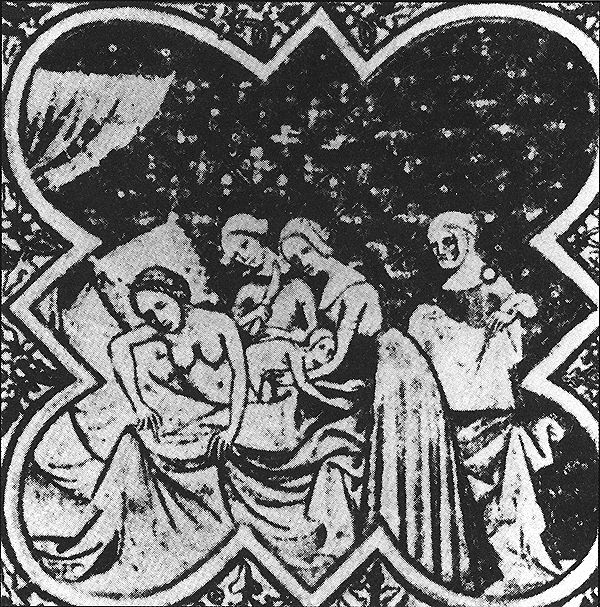
In Christian tradition, suffering was seen as a divine trial. Easing pain was sometimes viewed as interfering with God’s will. Stained-glass windows in churches often showed the importance of suffering. In the Book of Genesis, the phrase “you will give birth in pain” was taken literally. Women, especially, were expected to endure pain to redeem their sins. Relief finally came in the form of an unexpected substance: nitrous oxide, also known as laughing gas. In 1844, American dentist Horace Wells discovered its power and began using it on his patients. Excited by his results, he organized a public demonstration—but it failed. Present in the audience that day was William Morton, a doctor who improved Wells’s idea by using ether instead. Two years later, he presented his discovery in a crowded Massachusetts hospital. Before a silent audience of doctors and students, Morton placed an inhalation mask on a patient. Seconds later, the man fell asleep. Surgeon John Warren removed a tumor—without a single scream or movement. “Gentlemen, this is no illusion,” Warren announced. At that moment, medicine entered a new era. Ether had defeated pain, making surgical planning and precision finally possible. The turning point came when Queen Victoria, head of the Anglican Church, used anesthesia herself. After seven painful births, she delivered her eighth child under chloroform, administered by Dr. John Snow. In her diary, she described it as a blessing and an immense relief. Her approval legitimized anesthesia all over Europe, especially in obstetrics.
Advanced surgical methods in Uganda
In Uganda...
At the end of the 19th century in Uganda,
the British missionary and doctor Robert Felkin witnessed a cesarean section. To his great surprise, the procedure was carried out with both anesthesia and antisepsis. For anesthesia, the woman drank an alcoholic banana-based beverage. For antisepsis, her abdomen was washed with heated beer, and the incision was made with a sharpened knife that had been sterilized in fire. The wound was then covered with plant extracts. According to Felkin’s report, both the mother and the baby survived, and after only eleven days the wound was already healing remarkably well. This practice, once common in East Africa, had been forgotten in Western regions—likely because the history of surgery is also shaped by hierarchies and domination of knowledge. Patrick Riziki, a doctor and biologist, grew up in the Democratic Republic of Congo surrounded by traditional medical knowledge. He explains: “In my family, there was always someone who acted as the family doctor. My parents learned certain theories and techniques from my grandparents. For example, when we had stomach pain, my father could easily go outside, pick a plant, and give it to us to ease the pain. Traditional medicine is passed down from father to son.”
But colonization broke this chain of transmission. Today, people around the world benefit from the advances of Western medicine, but the knowledge of medicinal plants used by Patrick’s ancestors for generations has unfortunately been largely lost. In recent years, however, some have begun working to revive this knowledge. The World Health Organization has been recommending for more than twenty years that countries find ways to integrate traditional medicine into their healthcare systems. “When you take a leaf, extract it or make an infusion, you can find an active ingredient that is very useful sometimes even comparable to an antibiotic,” Patrick explains. Thanks to his medical training, he is able to better understand the effectiveness of many traditional remedies. However, Patrick is not a blind defender of traditional medicine. As a practitioner in the DRC, he has also seen its limitations, especially when beliefs or lack of information put lives in danger, such as in the case of cesarean sections. “There was a stigma around C-sections: women who needed one were seen as ‘not strong enough,’ because a strong woman was expected to give birth naturally. Even accepting the procedure was complicated for some women,” he says. Today, access to cesarean sections still depends heavily on women’s living conditions. Patrick explains: “In many places, the necessary structures simply aren’t there. Sometimes there’s a hospital but no doctor. And even when there is a doctor, people are afraid to go because they can’t afford it. There are also material problems: I’ve performed surgery where we were given only two sutures… So yes, the C-section remains a geographic privilege, closely tied to inequality.”
Conclusion
Ironically, in ancient times, Caesarean birth was already reserved for the powerful and the privileged.
But was Julius Caesar one of them?
Probably not. A C-section was an extremely dangerous procedure, and it was almost impossible for a woman to survive it. Yet we know that Julius Caesar’s mother was still alive more than 50 years after his birth which means she definitely did not give birth by Caesarean section. The word Caesarean actually comes from the Latin caedere, which means “to cut” or “to incise.” Since caedere and Caesar sound similar, people slowly linked the two, and the legend was born. Over time, this heroic myth spread everywhere, even though it was completely made up. In reality, it took centuries of knowledge, failed attempts, pain, and skilled hands to transform what was once a desperate last resort into a surgical operation that now saves countless lives.